
EKG Lead & Coronary Map
Interactive lead orientation, coronary territories & vessel correlates
Lead orientation
Coronary territories
Smith-Modified Sgarbossa Criteria
Concordant ST Elevation
Is there ≥1 mm ST elevation in any lead where the QRS is predominantly positive?
Concordant ST Depression
Is there ≥1 mm ST depression in V1–V3?
Excessively Discordant ST Elevation
Is there discordant ST elevation in a lead with a predominantly negative QRS?
The Rule
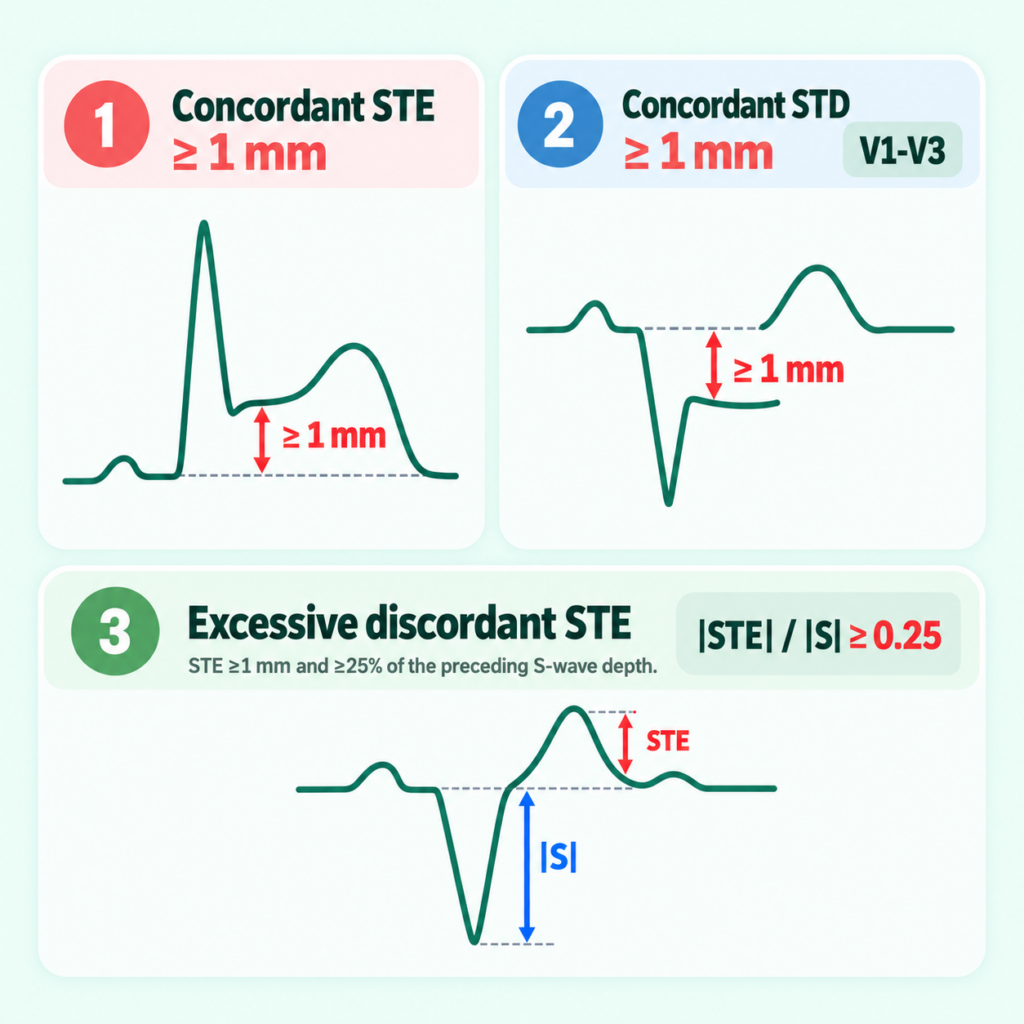
How to Measure Proportional Discordance
Measure the lead with discordant ST elevation
- Measure ST elevation at the J point relative to the PR-segment baseline.
- Measure the absolute depth of the preceding S wave.
- Divide STE by S-wave depth.
- Positive when STE is ≥1 mm and the ratio is ≥0.25.
Clinical Interpretation
- Any 1 criterion is positive. The modified rule is unweighted.
- Positive criteria are highly concerning for acute coronary occlusion when the clinical presentation is compatible and should accelerate an emergent reperfusion evaluation.
- Do not use a negative result to rule out OMI. Serial EKGs, symptoms, troponin trajectory, bedside echo, and angiography may still be needed.
- Best studied in LBBB. Modified Sgarbossa also performs better than the original criteria in ventricular paced rhythm.
Pitfalls
- Do not use the old 5 mm discordant STE cutoff. Large-voltage LBBB can produce >5 mm of normal discordance.
- Use the absolute S-wave depth when calculating the intuitive STE/S ratio. The original research expresses the negative S wave mathematically, so the published ST/S cutoff is ≤ −0.25.
- Measure at the J point relative to the PR-segment baseline. Small measurement errors matter near the 0.25 threshold.
- Look at every lead. Criterion 3 can occur anywhere; criterion 2 is specifically V1–V3 in the standard modified rule.
Smith-Modified Sgarbossa Digital Calipers
In any lead with a predominantly positive QRS, measure upward J-point displacement from the isoelectric baseline. Criterion positive at ≥1 mm.
In V1–V3 with a predominantly negative QRS, measure downward J-point displacement. Criterion positive at ≥1 mm.
In a lead with a predominantly negative QRS and discordant STE, complete two measurements in the same lead and beat: 1. Click the TP baseline, then the preceding S-wave nadir. 2. The TP baseline stays locked. Click only the J point above it. The tool calculates STE ÷ absolute S depth × 100. Positive when STE is ≥1 mm and the ratio is ≥25%.
View derivation study
View validation study
View paced-rhythm study
View LITFL review