
Atrial flutter and SVT can both present as a regular narrow-complex tachycardia and can be hard to differentiate.
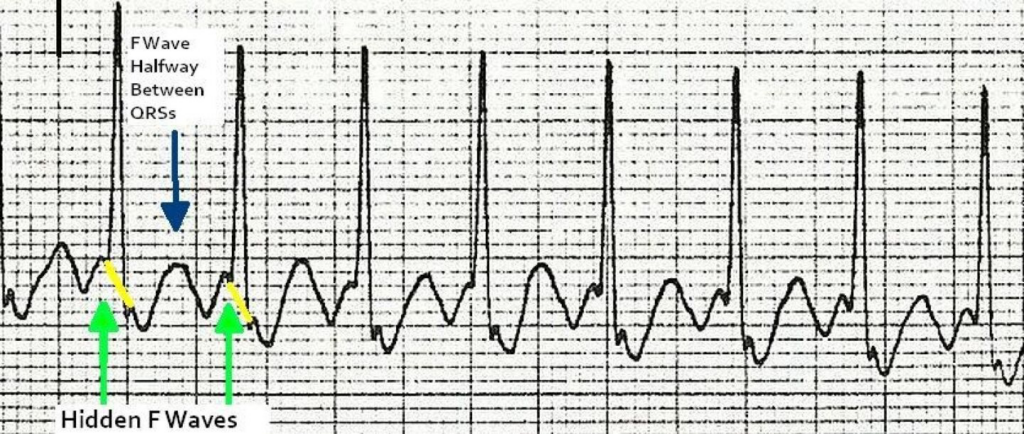
- 2:1 atrial flutter is frequently mistaken for SVT because flutter waves may be hidden within T waves. Carefully inspect inferior leads and V1
- Flutter often has atrial rates 250-350 bpm
- SVT usually has rates 150-250 bpm
Key EKG Clues
Atrial Flutter vs SVT
| Feature | Atrial Flutter | SVT |
|---|---|---|
| Typical ventricular rate | ~150 bpm with 2:1 block | 150-250 bpm |
| Rhythm | Regular or variable | Very regular |
| P waves | Sawtooth flutter waves, although hard to see in 2:1 or 1:1 | Often hidden or retrograde |
| Baseline | No true isoelectric baseline | Usually flat baseline |
| Best leads | II, III, aVF, V1 | P waves often difficult to see |
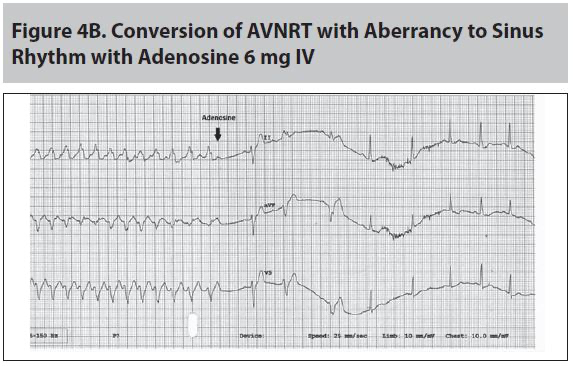
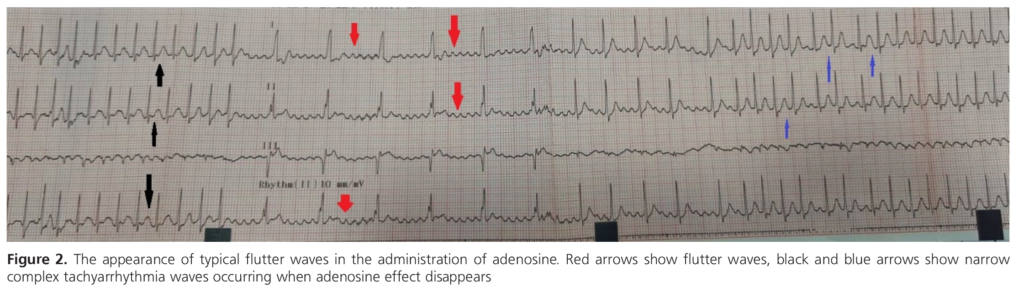
| Adenosine effect | Reveals flutter waves | Often terminates rhythm |
When in doubt...
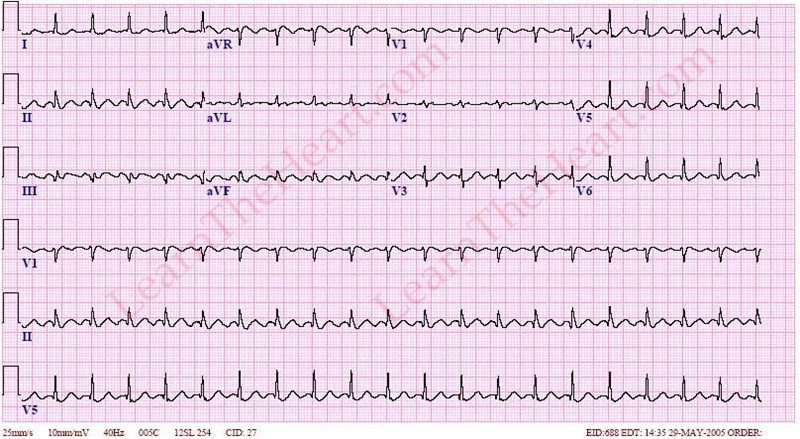
- A regular narrow-complex tachycardia at ~150 bpm is atrial flutter until proven otherwise
Suggests Atrial Flutter
- Rate persistently around 150 bpm
- Sawtooth waves in inferior leads
- Flutter waves visible in V1
- Adenosine slows AV conduction but does not terminate rhythm
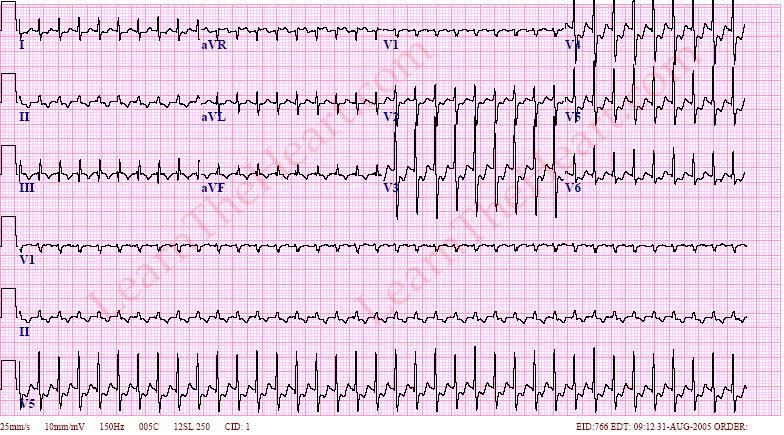
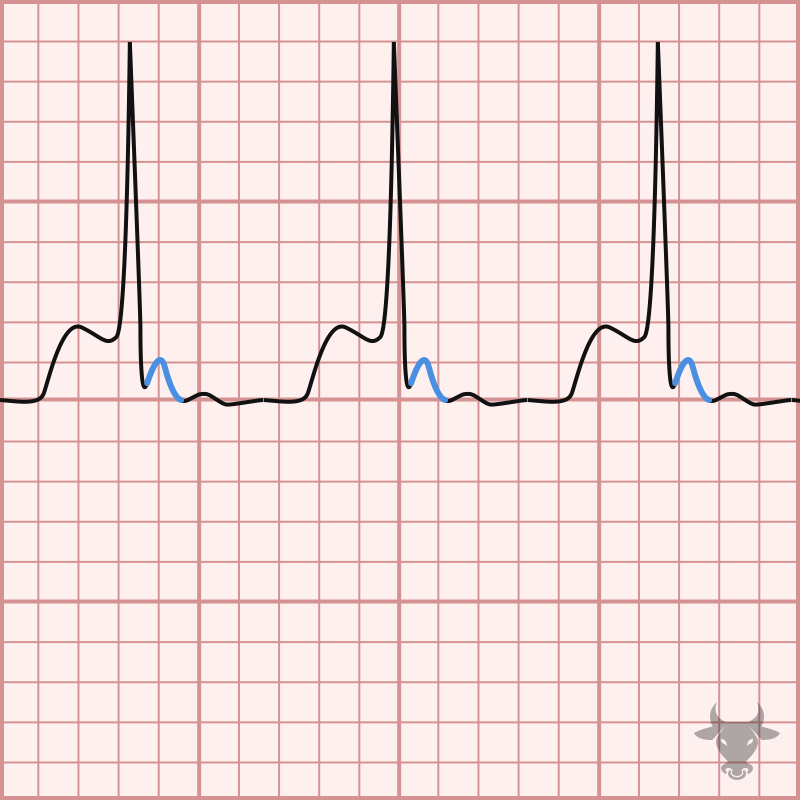
Suggests SVT
- Sudden onset/termination
- Extremely regular rhythm
- No clear flutter waves
- Adenosine terminates tachycardia
Best way to distinguish
- Give adenosine to slow them down and look for flutter waves (if atrial flutter) versus termination entirely to NSR (if SVT)
References
- Page, R. L., Joglar, J. A., Caldwell, M. A., Calkins, H., Conti, J. B., Deal, B. J., Estes, N. A. M., III, Field, M. E., Goldberger, Z. D., Hammill, S. C., Indik, J. H., Lindsay, B. D., Olshansky, B., Russo, A. M., Shen, W.-K., Tracy, C. M., & Al-Khatib, S. M. (2016). 2015 ACC/AHA/HRS guideline for the management of adult patients with supraventricular tachycardia. Journal of the American College of Cardiology, 67(13), e27–e115. https://doi.org/10.1016/j.jacc.2015.08.856
- Katritsis, D. G., Boriani, G., Cosio, F. G., Hindricks, G., Jais, P., Josephson, M. E., Keegan, R., Kim, Y.-H., Knight, B. P., Kuck, K.-H., Lane, D. A., Lip, G. Y. H., Malmborg, H., Oral, H., Pappone, C., & Themistoclakis, S. (2020). 2019 ESC guidelines for the management of patients with supraventricular tachycardia. European Heart Journal, 41(5), 655–720. https://doi.org/10.1093/eurheartj/ehz467
- Cosío, F. G. (2017). Atrial flutter, typical and atypical: A review. Arrhythmia & Electrophysiology Review, 6(2), 55–62. https://doi.org/10.15420/aer.2017.5.2
- Gupta, A., Perera, T., Ganesan, A., Sullivan, T., Lau, D. H., Roberts-Thomson, K. C., & Sanders, P. (2021). Adenosine: A drug with myriad utility in the diagnosis and treatment of arrhythmias. Journal of Arrhythmia, 37(1), 103–112. https://doi.org/10.1002/joa3.12456
- Saoudi, N., Cosío, F., Waldo, A., Chen, S.-A., Iesaka, Y., Lesh, M., Saksena, S., Salerno, J., Schoels, W., & Working Group of Arrhythmias of the European Society of Cardiology. (2001). Classification of atrial flutter and regular atrial tachycardia according to electrophysiologic mechanism and anatomic bases: A statement from a joint expert group. European Heart Journal, 22(14), 1162–1182. https://doi.org/10.1053/euhj.2001.2658