
Renal Resistive Index Calculator
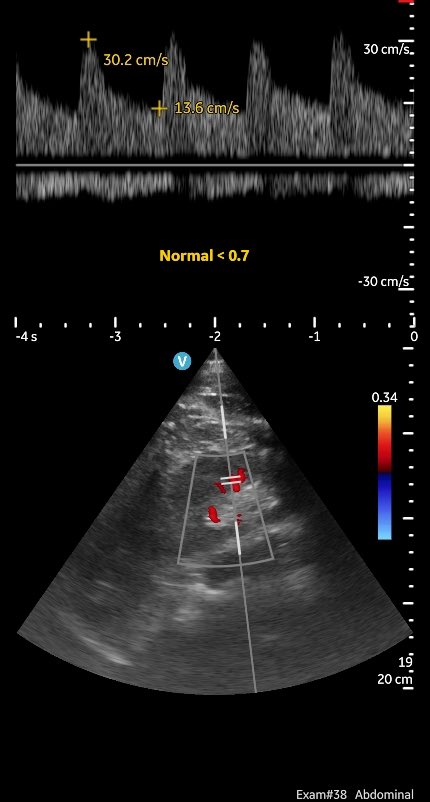
The renal arterial resistive index (RI) is a sonographic measurement of intrarenal artery resistance, calculated as:
(Peak Systolic Velocity) - (End-Diastolic Velocity) / (Peak Systolic Velocity)
- The normal RI range is 0.50-0.70. Elevated RI values are associated with poorer prognosis in various renal disorders and renal transplant outcomes.
Technique
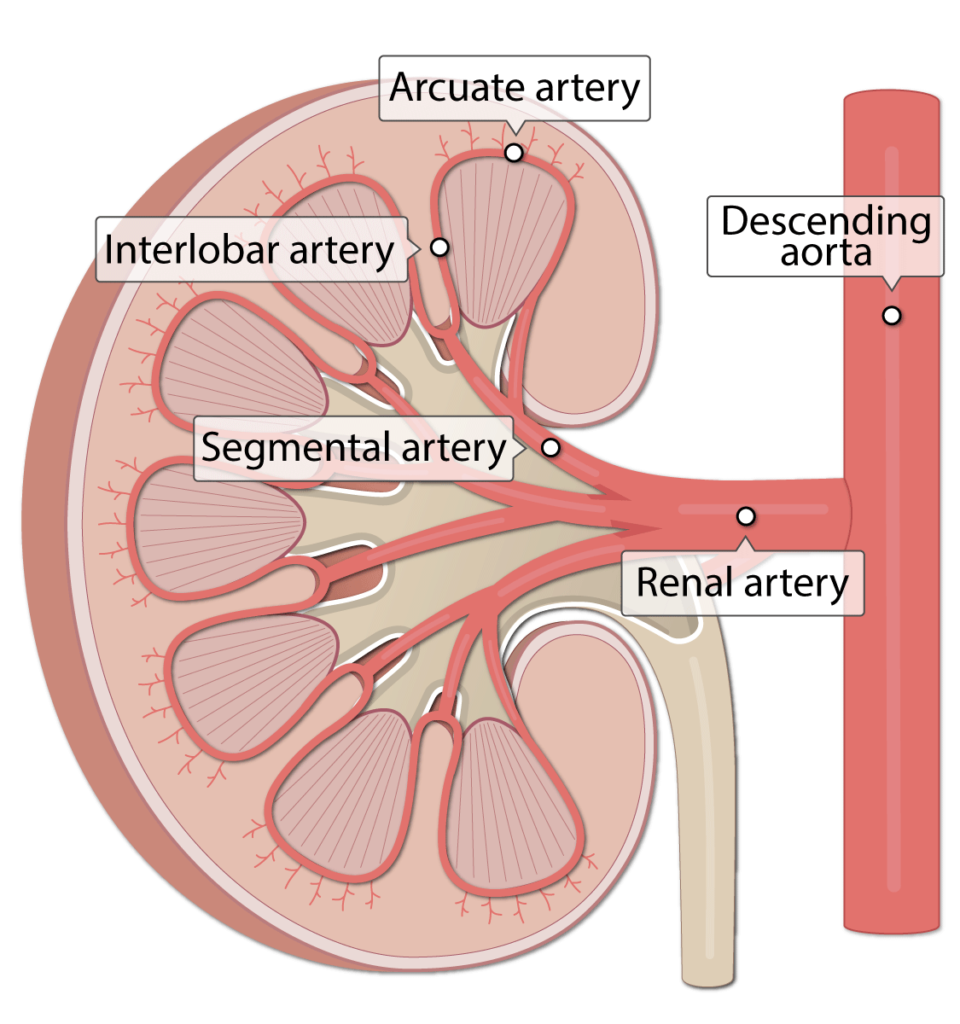
RI is measured using spectral Doppler at either:
- Arcuate arteries (at the corticomedullary junction)
- Interlobar arteries (adjacent to medullary pyramids)
Significance
RI primarily reflects central hemodynamic factors (e.g., cardiac or aortic characteristics) rather than intrinsic renal properties. It indicates vascular compliance and pulsatility, often considered an “impedance index.”
High resistive indices (>0.8):
- In native kidneys: Associated with renal dysfunction and increased cardiovascular risk.
- In renal transplants: Linked to higher risk of graft loss and mortality.
Clinical Implications
Elevated RI
- Medical renal disease
- Ureteric obstruction
- Extreme hypotension
- Young children
- Perinephric fluid collection
- Abdominal compartment syndrome
- Acute tubular necrosis (ATN)
- Acute or chronic transplant rejection
- Renal vein thrombosis
- Drug toxicity
- Ureteric obstruction
- Perinephric fluid collection
Decreased RI
- Renal artery stenosis
References
- Tublin, M. E., Bude, R. O., & Platt, J. F. (2003). The resistive index in renal Doppler sonography: Where do we stand? American Journal of Roentgenology, 180(4), 885–892. https://doi.org/10.2214/ajr.180.4.1800885
- Platt, J. F., Ellis, J. H., Rubin, J. M., DiPietro, M. A., & Sedman, A. B. (1990). Intrarenal arterial Doppler sonography in patients with nonobstructive renal disease: Correlation of resistive index with biopsy findings. American Journal of Roentgenology, 154(6), 1223–1227. https://doi.org/10.2214/ajr.154.6.2110732
- Radermacher, J., Mengel, M., Ellis, S., Stuht, S., Hiss, M., Schwarz, A., Eisenberger, U., Burg, M., Luft, F. C., & Gwinner, W. (2003). The renal arterial resistance index and renal allograft survival. New England Journal of Medicine, 349(2), 115–124. https://doi.org/10.1056/NEJMoa022602
- Naesens, M., Heylen, L., Lerut, E., Claes, K., De Wever, L., Claus, F., Oyen, R., Kuypers, D., Evenepoel, P., Bammens, B., Sprangers, B., Meijers, B., Pirenne, J., Monbaliu, D., de Jonge, H., & Vanrenterghem, Y. (2013). Intrarenal resistive index after renal transplantation. New England Journal of Medicine, 369(19), 1797–1806. https://doi.org/10.1056/NEJMoa1301064
- Viazzi, F., Leoncini, G., Derchi, L. E., Pontremoli, R., & Ravera, M. (2014). Ultrasound Doppler renal resistive index: A useful tool for the management of the hypertensive patient. Journal of Hypertension, 32(1), 149–153. https://doi.org/10.1097/HJH.0b013e328365b29c
- American Institute of Ultrasound in Medicine, American College of Radiology, Society for Pediatric Radiology, & Society of Radiologists in Ultrasound. (2023). AIUM practice parameter for the performance of duplex sonography of native renal vessels. Journal of Ultrasound in Medicine, 42(12), E1–E8. https://doi.org/10.1002/jum.16353