
VT Localizer
Cheat Sheet
| Finding | Suggests |
|---|---|
| LBBB VT | RV origin |
| RBBB VT | LV origin |
| Inferior axis | Outflow tract or superior origin |
| LBBB + inferior axis | Classic RVOT VT pattern |
| High MDI | Epicardial VT |
| Structural abnormalities or scar | Idiopathic VT less likely |
RV or LV
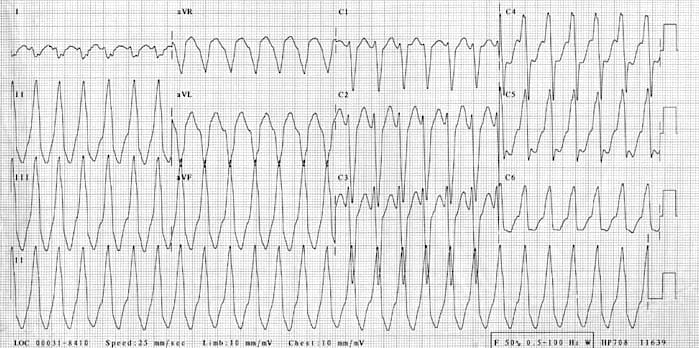
LBBB morphology
- Mostly negative in V1
- Usually means VT starts in the RV
- Reason: activation moves right to left
- Examples
- RVOT VT
- Other RV free wall VT
- ARVC-related VT
RBBB morphology
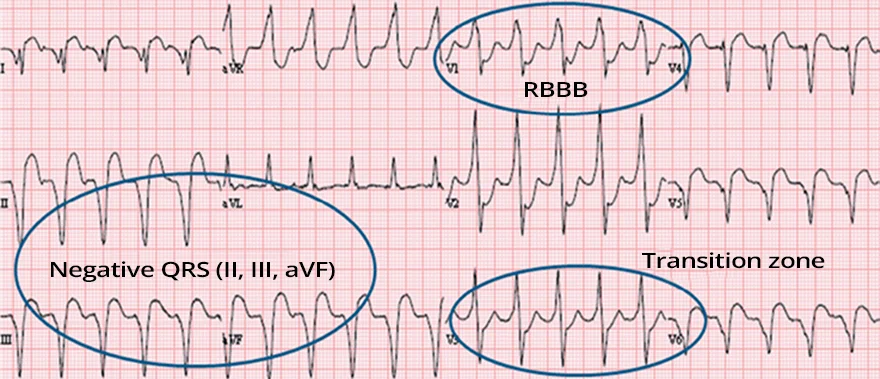
- Mostly positive in V1
- Usually means VT starts in the LV
- Reason: activation moves left to right
- Examples
- LV scar VT
- Fascicular VT
- LV summit / LVOT VT
Axis
Inferior axis
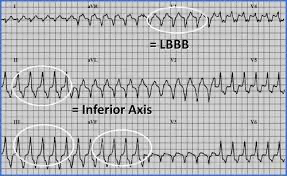
- Positive in II, III, aVF
- Impulse is traveling downward
- Suggests a superior origin
- Examples
- RVOT VT
- LVOT VT
Superior axis
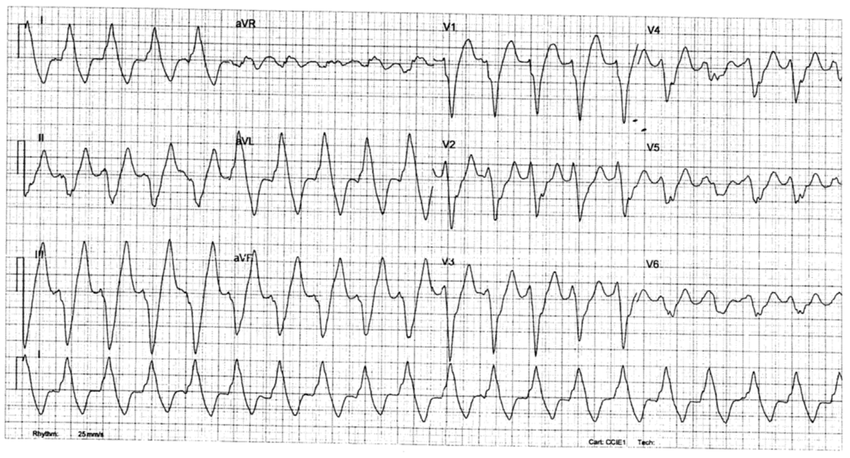
- Negative in II, III, aVF
- Impulse is traveling upward
- Suggests an inferior origin
- Examples
- Inferior scar VT
- Apical or inferior ventricular origin
Precordial Transition
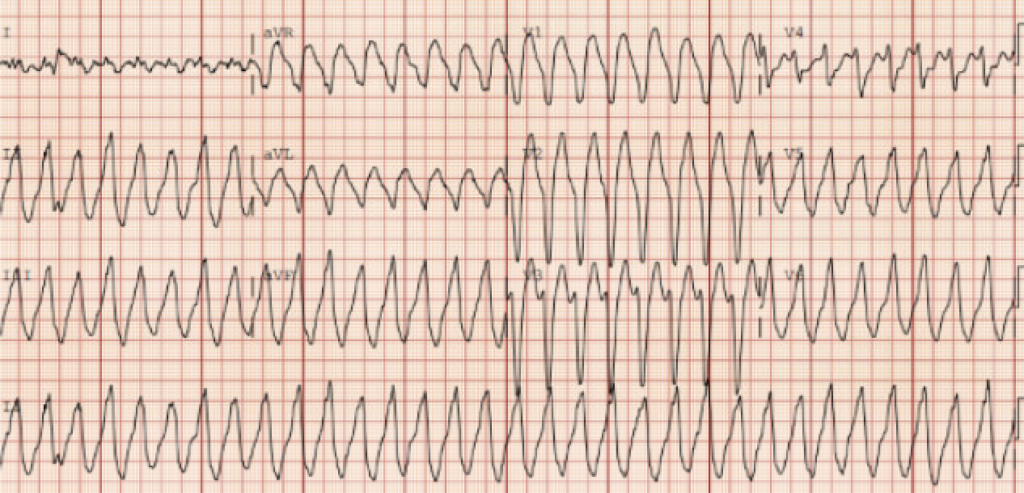
Late Transition
- More rightward / later transition can support RVOT origin
- Transition ≥ V5
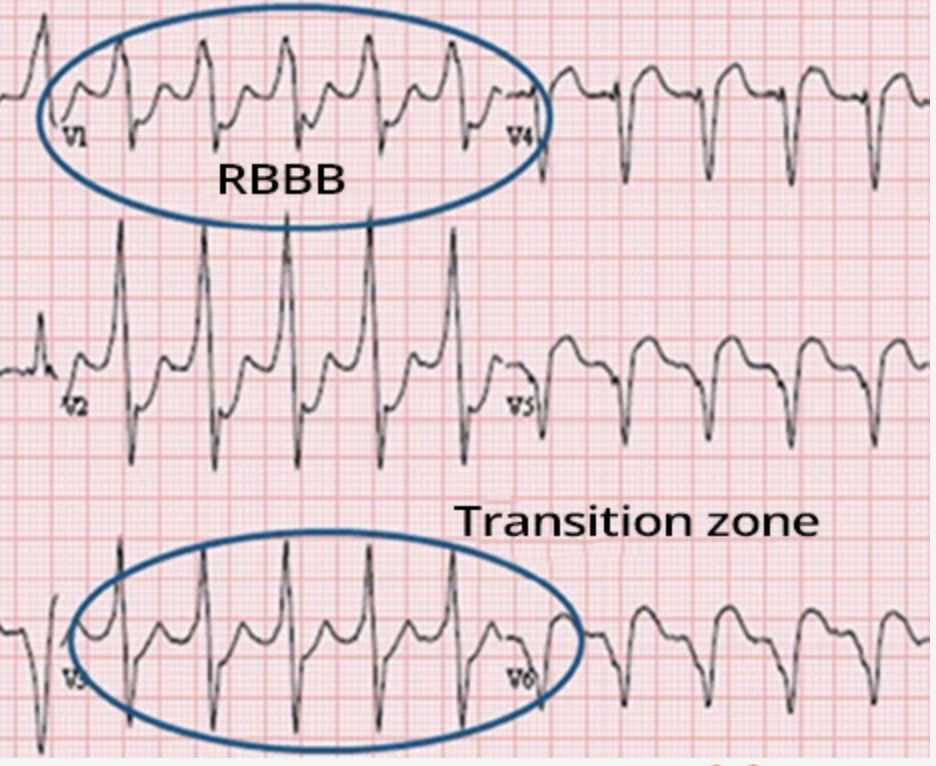
Early Transition
- Earlier transition can support LVOT origin
- Transition in V1-V3
Maximum Deflection Index (MDI)
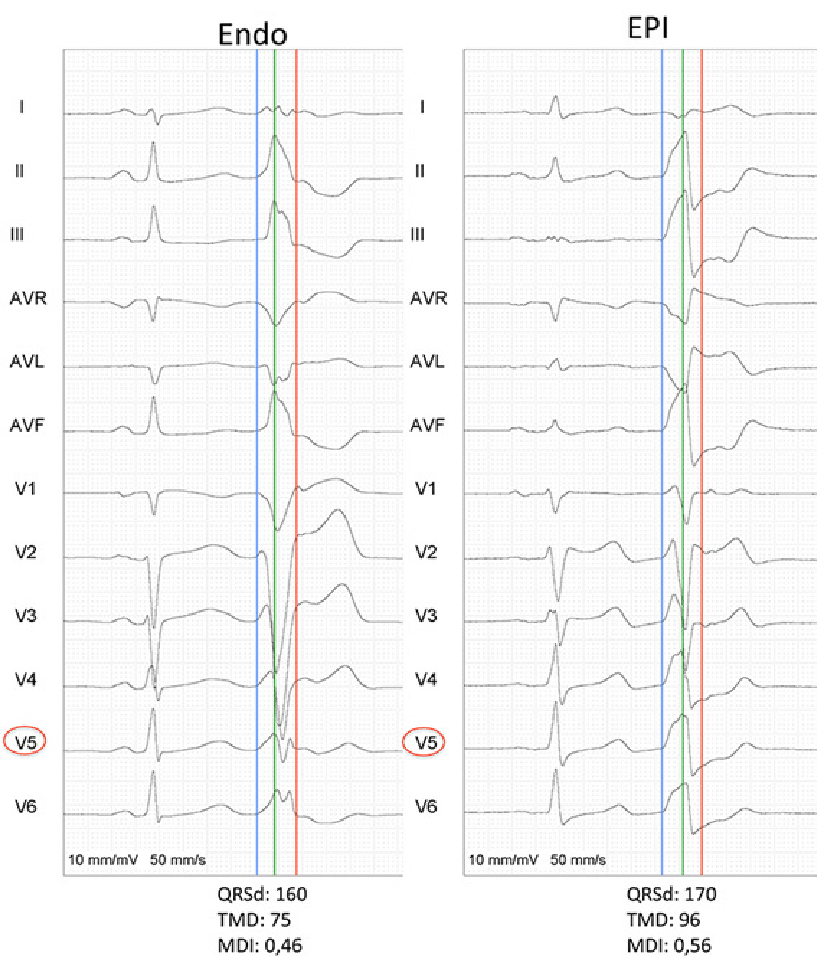
MDI helps predict epicardial vs endocardial origin
- MDI = time from QRS onset to maximum deflection / total QRS duration
- Helps plan epicardial (riskier) vs endocardial ablation
- Helps determine what disease process may be causing scar
- Pick a precordial lead with a clear VT complex
- Mark QRS onset
- Mark the point of maximum positive or negative deflection
- Measure: onset to maximum deflection and total QRS duration
- Divide the first by the second
- Interpretation
- MDI < 0.55: endocardial origin more likely
- MDI ≥ 0.55 to 0.60: epicardial origin more likely
Maximum Deflection Index Calculator
References
- Yamada, T., McElderry, H. T., Doppalapudi, H., Okada, T., Murakami, Y., Yoshida, Y., Yoshida, N., Inden, Y., Murohara, T., Plumb, V. J., Kay, G. N., & Epstein, A. E. (2008). Idiopathic ventricular arrhythmias originating from the aortic root: Prevalence, electrocardiographic and electrophysiologic characteristics, and results of radiofrequency catheter ablation. Journal of the American College of Cardiology, 52(2), 139–147. https://doi.org/10.1016/j.jacc.2008.03.041
- Betensky, B. P., Park, R. E., Marchlinski, F. E., Hutchinson, M. D., Garcia, F. C., Dixit, S., Callans, D. J., Cooper, J. M., Bala, R., Lin, D., Riley, M. P., Gerstenfeld, E. P., & Dixit, S. (2011). The V2 transition ratio: A new electrocardiographic criterion for distinguishing left from right ventricular outflow tract tachycardia origin. Journal of the American College of Cardiology, 57(22), 2255–2262. https://doi.org/10.1016/j.jacc.2011.01.035
- Daniels, D. V., Lu, Y. Y., Morton, J. B., Santucci, P. A., Akar, J. G., Green, A., Wilber, D. J., & Ouyang, F. (2006). Idiopathic epicardial left ventricular tachycardia originating remote from the sinus of Valsalva: Electrocardiographic characteristics, catheter ablation, and identification from the 12-lead electrocardiogram. Circulation, 113(13), 1659–1666. https://doi.org/10.1161/CIRCULATIONAHA.105.611640
- Berruezo, A., Mont, L., Nava, S., Chueca, E., Bartholomay, E., & Brugada, J. (2004). Electrocardiographic recognition of the epicardial origin of ventricular tachycardias. Circulation, 109(15), 1842–1847. https://doi.org/10.1161/01.CIR.0000125525.04081.4B
- Yoshida, N., Inden, Y., Uchikawa, T., Kamiya, H., Kitamura, K., Shimano, M., Tsuji, Y., Hirai, M., Murohara, T., & Yamada, T. (2011). Novel transitional zone index allows more accurate differentiation between idiopathic right ventricular outflow tract and aortic sinus cusp ventricular arrhythmias. Heart Rhythm, 8(3), 349–356. https://doi.org/10.1016/j.hrthm.2010.11.023
- Cronin, E. M., Bogun, F. M., Maury, P., Peichl, P., Chen, M., Namboodiri, N., Aguinaga, L., Leite, L. R., Al-Khatib, S. M., Anter, E., Berruezo, A., Callans, D. J., Chung, M. K., Cuculich, P., d’Avila, A., Deal, B. J., Della Bella, P., Deneke, T., Dickfeld, T. M., ... Zeppenfeld, K. (2020). 2019 HRS/EHRA/APHRS/LAHRS expert consensus statement on catheter ablation of ventricular arrhythmias. Heart Rhythm, 17(1), e2–e154. https://doi.org/10.1016/j.hrthm.2019.03.002