
JT Interval
JTc calculated using Fridericia correction: JTc = JT / RR1/3
Why use JT instead of QT?
The JT interval reflects the actual time for ventricular repolarization. It starts at the end of the QRS complex and ends at the end of the T wave. It is essentially the QT interval minus the time spent in ventricular conduction.
When the QRS is prolonged, the QT interval becomes falsely elevated because it includes both conduction and repolarization time. This makes the QTc misleading in several situations:
- LBBB
- RBBB
- Ventricular pacing
- Pre-excitation such as WPW
- Ventricular escape rhythms
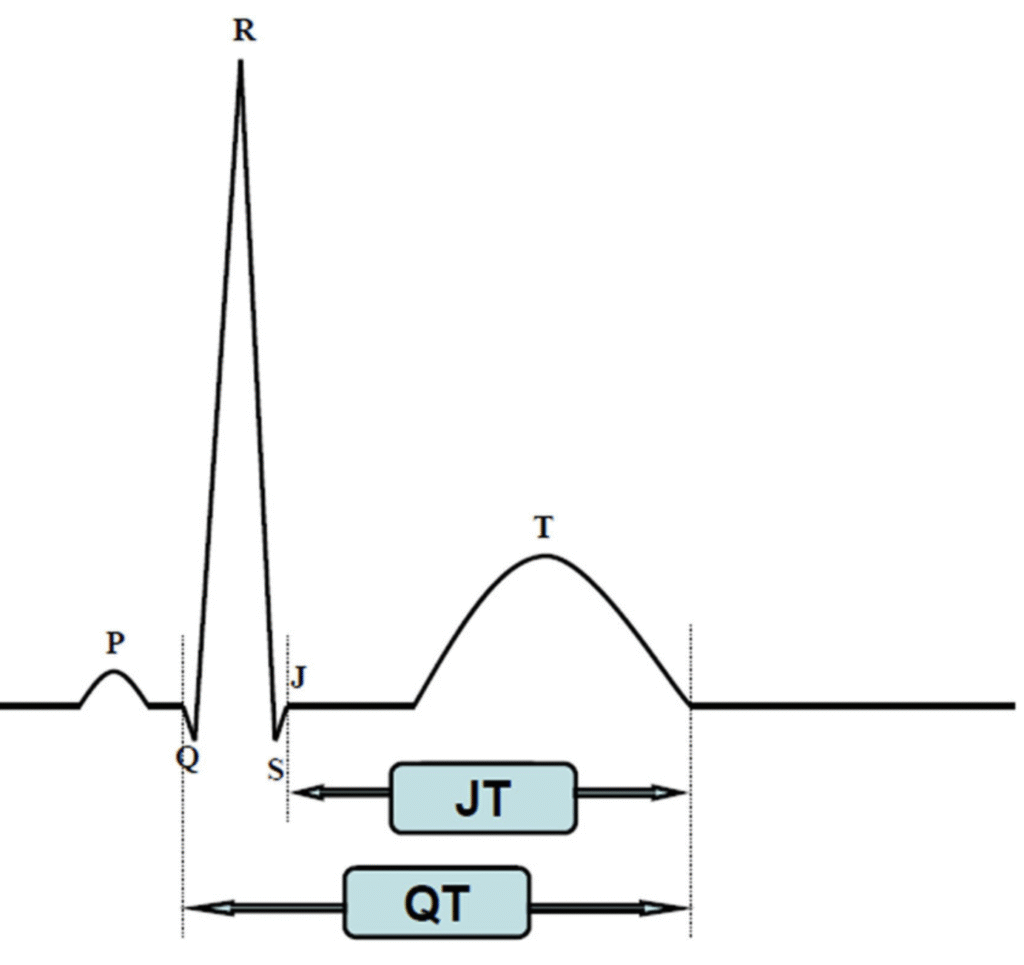
When to use JT interval?
- Use JT (and JTc) when the QRS duration is 120 ms or greater
- A rough cutoff is that any QT>350ms is abnormal
- The JT interval is calculated by subtracting the QRS duration from the QT interval (QT-QRS), isolating the time of ventricular repolarization. To adjust for HR, the JT interval is corrected using the Fridericia formula: JTc = JT ÷ (RR)^(1/3)
Validation Study
One of the most cited modern validations: https://pubmed.ncbi.nlm.nih.gov/25929581/
- Risk of Mortality Associated with QT and JT Intervals
Design
- ~8,000 patients, long-term follow-up (up to 18 yrs)
Key finding
- In patients with QRS ≥120 ms:
- JT was a much stronger predictor of mortality than QT
- JT HR ≈ 4.75 vs QT HR ≈ 1.5
Interpretation
- QT is contaminated by QRS widening
- JT isolates repolarization → better risk signal
References
- Zulqarnain, M. A., Qureshi, W. T., O’Neal, W. T., Shah, A. J., Soliman, E. Z., & Maziar, Z. (2015). Risk of mortality associated with QT and JT intervals at different levels of QRS duration. American Journal of Cardiology, 116(1), 74–78. https://doi.org/10.1016/j.amjcard.2015.03.034
- Rautaharju, P. M., Surawicz, B., Gettes, L. S., Bailey, J. J., Childers, R., Deal, B. J., Gorgels, A., Hancock, E. W., Josephson, M., Kligfield, P., Kors, J. A., Macfarlane, P., Mason, J. W., Mirvis, D. M., Okin, P., Pahlm, O., & van Herpen, G. (2009). AHA/ACCF/HRS recommendations for the standardization and interpretation of the electrocardiogram: Part IV: The ST segment, T and U waves, and the QT interval. Journal of the American College of Cardiology, 53(11), 982–991. https://doi.org/10.1016/j.jacc.2008.12.014
- Rautaharju, P. M., Zhang, Z.-M., Prineas, R., & Heiss, G. (2004). Assessment of prolonged QT and JT intervals in ventricular conduction defects. American Journal of Cardiology, 93(8), 1017–1021. https://doi.org/10.1016/j.amjcard.2003.12.055
- Crow, R. S., Hannan, P. J., & Folsom, A. R. (2003). Prognostic significance of corrected QT and corrected JT interval for incident coronary heart disease in a general population sample stratified by presence or absence of wide QRS complex: The ARIC study. Circulation, 108(16), 1985–1989. https://doi.org/10.1161/01.CIR.0000095027.28753.9D
- Vandenberk, B., Vandael, E., Robyns, T., Vandenberghe, J., Garweg, C., Foulon, V., Ector, J., Willems, R., & Spriet, I. (2016). Which QT correction formulae to use for QT monitoring? Journal of the American Heart Association, 5(6), e003264. https://doi.org/10.1161/JAHA.116.003264
- Bogossian, H., Frommeyer, G., Ninios, I., Hasan, E. P., Nguyen, Q. S., Karosiene, Z., & Dechering, D. G. (2020). QTc evaluation in patients with bundle branch block. International Journal of Cardiology Heart & Vasculature, 30, 100636. https://doi.org/10.1016/j.ijcha.2020.100636